
Claude Code: Widening the Gap in the New Era
Original article: https://mp.weixin.qq.com/s/OUm-pd70x6g-wJeNzvNXVw
AllinSense AIxChem 2025-11-18 23:31
Claude Code: Widening the Gap in the New Era
for More:- https://allinsense.net
From Struggling to Sprinting
1. Removing Repetitive Work from Developers' Minds
Most development tasks aren't difficult, but they're highly repetitive and continuously drain developers' energy:
Writing CRUD (Create, Read, Update, Delete) over and over
Implementing the same validation logic repeatedly
Writing similar SQL queries for reports again
Building page structures from scratch
Constantly updating and revising documentation
These aren't technical challenges—they're mental energy drains.
Claude Code can handle all these "dirty jobs" completely,
freeing developers from low-value repetitive tasks.
The developer's work upgrades from "writing repetitive code" to "reviewing and optimizing".
Attention is no longer fragmented by trivial tasks, allowing greater focus on truly valuable business logic and architectural thinking.
2. From "Fear of Making Mistakes" to "Confident Changes"—Drastically Reduced Pressure
In daily development, mental burden often comes from these real scenarios:
Write fast, fear mistakes
Write slow, get pressured
Modify legacy code, fear accidents
Incomplete documentation, stuck staring
Requirements change mid-code
Claude Code can reduce these pressures by about 95% :
- Incomplete documentation?
Claude Code can directly analyze source code, automatically generate accurate API and logic documentation, and help write unit tests for verification. Truly "having everything under control" during project handoffs.
- Too many manual tasks leading to errors?
Let Claude Code generate code following your patterns, outputting zero-syntax-error, style-consistent versions. You only need to do the final review.
- Legacy project like a "messy codebase" with chaotic coupling?
Claude Code can meticulously analyze complex code, summarize implicit logic, generate test cases, and guide gradual optimization or refactoring.
Git provides a safety net—you no longer need to fear touching old code.
- Frequent requirement changes?
Let Claude Code quickly generate new versions. You just review results, no longer worrying about coupling, defects, or omissions.
The underlying logic is simple—
AI handles the high-risk parts; you make the high-value decisions.
Development → Testing → Operations
Complete Pipeline Upgrade
1. Data Flow Perspective for Problem Investigation—End-to-End Acceleration
When investigating issues, Claude Code can start from the overall data flow:
Analyze data flow across services and modules
Correlate logs, call chains, and anomalies
Identify potential boundary issues
Provide verifiable hypotheses and paths
LLM's rigor in logical reasoning far exceeds humans,
continuously shortening the overall cycle of communication, investigation, and verification.
In one sentence:
Don't argue—show me your code, and let Claude Code infer the real problem.
The entire pipeline becomes unprecedentedly smooth under this mechanism.
2. Cross-Domain Communication No Longer Painful
Claude Code can serve as a "professional translator," acting as a communication lubricant within teams:
People with different professional backgrounds translate each other's terminology through Claude Code
Logic and data relationships between different systems are automatically aligned by Claude Code
Documentation, instructions, and requirements are unified into structured expressions
Communication efficiency shifts from "guessing" to "verifying,"
dramatically reducing communication costs.
The ultimate effect often approaches:
Nearly 10x efficiency improvement.
R&D Mastery
1. Extracting Actionable Solutions from Complex Data Relationships
Claude Code can automatically:
Analyze business logic after receiving requirements
Extract key data relationships
Find actionable design approaches
Provide structured implementation plans
The situation of "I understand the requirements but don't know how to start" will significantly decrease.
2. Extracting Key Logic from Complex Source Code
Whether it's legacy systems with mixed languages or massive open-source projects, Claude Code just needs the repository input to analyze core logic from a "data flow perspective":
How code is organized
How functionality is layered
Which modules can be reused
Which parts are worth rewriting
Which designs can be borrowed
Which details are worth aligning
This means catching up with cutting-edge technology no longer depends on "reading all the source code,"
but starting from key paths to understand, greatly reducing mental burden.
Why Claude Code?
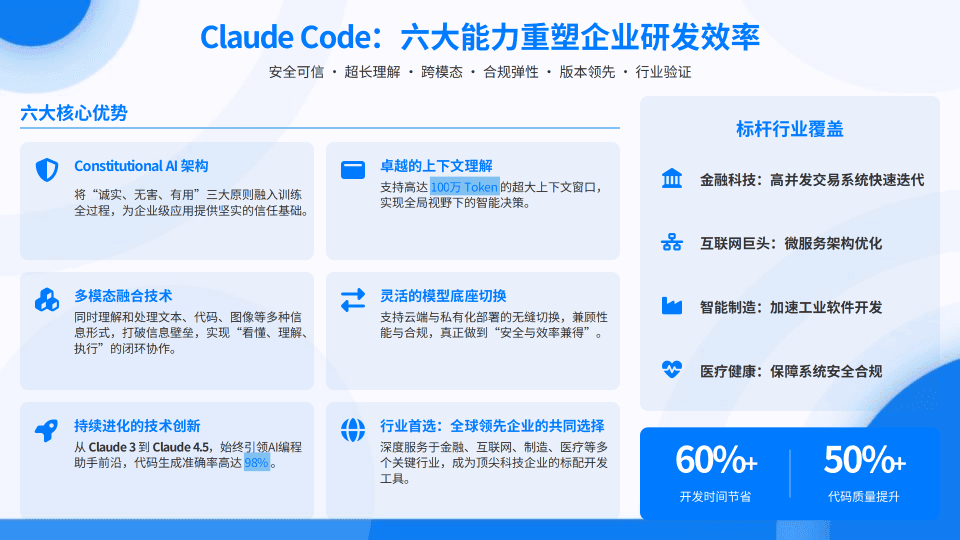
The reason it's Claude Code, not other tools, fundamentally lies in it being not just "easy to use," but having industry-infrastructure-level openness.
First, the Claude team proposed the widely recognized MCP (Model Context Protocol) standard in the AI field.
MCP provides a unified communication method between AI and tools, enabling any system, plugin, or enterprise internal tool to be called by AI in a standardized way.
This means the entire future ecosystem will align with this protocol, exponentially increasing innovation speed and compatibility.
Second, Claude Code is model-neutral.
It can not only use Claude itself but also freely switch between different vendors' and capabilities' LLMs, even using enterprise self-built models.
All models' context, format, and calling methods are uniformly coordinated by Claude Code. Teams are no longer limited to a single vendor, nor worried about lock-in risks from future ecosystem changes.
Combining these two points forms a clear advantage:
Claude Code is not a tool, but an open, extensible, replaceable future development platform.
It can continuously evolve with industry, model, and ecosystem changes, rather than being tied to any technology in the present.
In an era of ever-faster iteration, choosing Claude Code essentially means choosing:
A continuously growing ecosystem
A workflow with freely switchable models
An infrastructure adaptable to future changes
This is why the real gap isn't in tool functionality, but in the tool's "future position."